












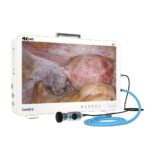



Camjoy CY802 & CY803 Plasma Kinetic Systems
✔ 345Khz High-Frequency Stability
✔ Low Thermal Damage (40°C-70°C)
✔ HoLEP-Ready Hemostasis
Unlocking the Power of Plasma Kinetic Technology
Modern endoscopic surgery demands energy sources that prioritize patient safety without sacrificing resection speed. The Camjoy CY802 and CY803 Bipolar Plasma Systems utilize a localized 345Khz high-frequency carrier to ionize 0.9% saline, creating a high-energy plasma corona. This field molecularly dissolves tissue at a lower temperature than traditional electrosurgery, resulting in a cleaner surgical bed and faster patient recovery.
The CY802 Urology System is the preferred choice for Transurethral Resection in Saline (TURS). It addresses the most common fears in TURP—bleeding and TUR syndrome—by creating a true hemostatic vaporization effect. Meanwhile, the CY803 Series is factory-tuned for Gynecology Hysteroscopy, providing the delicate energy modulation required to treat intrauterine lesions while preserving fertility.
System Modularity: These generators are the engine for our high-precision optics. For urology, they pair flawlessly with the BRS108 Resectoscope Series. To capture the entire procedure in 4K clarity, we recommend integration with the CF501 Electronic Imaging Platform.
Clinical & Hardware Advantages
- ✔ Saline Resection (TURS): Eliminates water intoxication and hyponatremia risks.
- ✔ Pressurized T-Modes: T1 and T2 modes deliver a boosted output to handle dense, fibrotic prostate glands.
- ✔ Smart Electrode Sensing: Real-time tracking of electrode wear in the Urology Accessories ecosystem ensures fragment-free surgery.
- ✔ No Patient Return Pad: True bipolar circuit prevents stray current burns and is safer for patients with metallic implants.
- ✔ Low Heat Depth: Only 0.5mm – 1.0mm thermal penetration protects erectile and uterine nerves.
Advanced Intelligent Plasma Modes
1. Dynamic Vaporization & Cutting
The CY802/803 features seven distinct output levels. Level T1 and T2 utilize a Pressurized Output Algorithm that maintains a stable plasma corona even when the electrode is fully immersed in deep irrigation flow, ensuring zero-drag cutting through the largest adenomas.
2. Acoustic Coagulation Logic
Safety in the OR is enhanced through audible feedback. The system emits varying prompt tones based on the state of tissue coagulation. This allows the surgeon to determine the completion of vessel sealing by sound, maintaining visual focus on the HD Surgical Monitor.
3. Multi-Color Industrial Design
Available in Classic White (8021/8031), Obsidian Black (8022/8032), and High-Vis Orange (8023/8033). This allows hospitals to differentiate equipment by department (Urology vs. GYN) or by specific OR clusters.
🌟 Breakthroughs in Bipolar Electrosurgery
🔬
Low Thermal Profile
Operates at 40°C-70°C, drastically reducing the risk of postoperative scarring and nerve damage.
🧠
Auto-ID Technology
Intelligently matches energy levels to the specific Plasma Electrode without manual calibration.
🔗
Ecosystem Compatibility
Seamlessly integrates with YJ Series Rigid Ureteroscopes and Resectoscopes.
💧
Sticky-Free Resection
The plasma field ensures the electrode loop never sticks to the tissue, maintaining high surgical efficiency.
📊
Real-Time Wear Tracking
Monitors electrode degradation to ensure no metallic fragments are left in the body.
⚡
Zero Nerve Stimulation
Bipolar energy confinement prevents “leg jumping” caused by obturator nerve stimulation during bladder tumor resection.
📊 Technical Specifications (CY802 & CY803 Series)
| Parameter Category | Specifications & Operating Range |
|---|---|
| Output & Energy Management | |
| Main Carrier Frequency | 345Khz (±10%) |
| Maximum Power Output | 200W / 300Ω (Peak Performance for dense tissue) |
| Resection Modes | 7 Levels (Including T1/T2 Pressurized Cutting) |
| Energy Medium | 0.9% Normal Saline (NaCl) Solution |
| Hardware & Input | |
| Global Power Compatibility | 100V – 250V ; 50-60Hz (Universal Power Supply) |
| Atmospheric Range | 700 – 1060 HPA |
| Operating Environment | Temp: 10-40°C | Humidity: 30%-75% |
| Clinical Integration | |
| Urology Matching | BRS108 Series & YJ Ureteroscopes |
| Consumable Path | Urology Plasma Electrodes & Accessories |
❓ Clinical FAQ: The Science of Plasma Resection
Request a System Configuration
Equip your facility with the gold standard in bipolar plasma kinetic energy.
Partner with Camjoy
Fill out the form below to receive a custom quote for the CY802/CY803 and matching Urology Instruments.