














Advanced Bipolar Urology
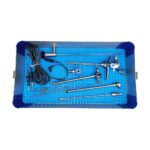
Camjoy BRS107 Bipolar Resectoscope Set
✔ Saline Plasma TURP
✔ 282mm Short Optic
✔ Adjustable Obturator
Redefining Safety in Transurethral Resection
For decades, Transurethral Resection of the Prostate (TURP) has been the gold standard for treating Benign Prostatic Hyperplasia (BPH). However, traditional monopolar systems utilizing non-conductive fluids (such as glycine or mannitol) carry the inherent risk of T.U.R. Syndrome—a potentially life-threatening complication caused by the absorption of hypotonic fluid. Furthermore, the risk of obturator nerve reflex and thermal injury to surrounding tissues has always been a concern for urologists performing complex resections.
The Camjoy BRS107 Bipolar Resectoscope System represents a monumental leap forward in electrosurgical safety and precision. By utilizing Bipolar Plasma Technology, the BRS107 allows the entire procedure to be performed in 0.9% Normal Saline (NaCl). This isotonic environment virtually eliminates the risk of dilutional hyponatremia (T.U.R. Syndrome), allowing surgeons to operate with confidence on larger prostates for extended periods without the time pressure associated with monopolar systems.
Distinct from standard resectoscopes, the BRS107 is engineered around a specialized 282mm Optical System. This unique form factor addresses a common ergonomic complaint: the “lever arm effect.” By shortening the distance between the surgeon’s hand and the distal tip, the BRS107 offers unparalleled tactile feedback and balance, reducing hand fatigue during high-volume lists. Combined with our proprietary Click-Lock Mechanism, the system offers a rock-solid, wobble-free interface that defines modern urological precision.
Clinical Advantages
- ✔ Zero T.U.R. Syndrome: Saline irrigation prevents hyponatremia.
- ✔ Nerve Safety: Current is confined to the loop, protecting the obturator nerve.
- ✔ Hemostasis: Plasma creates a superior coagulation zone for clear vision.
- ✔ Pacemaker Safe: Minimal electrical interference with cardiac devices.
- ✔ Ergonomic Balance: Short 282mm design improves handling.
Engineering Excellence & Technology
1. The 282mm “Short-Shaft” Advantage
Standard resectoscopes typically utilize a 302mm working length. While effective, the extra length can displace the center of gravity away from the surgeon’s hand, creating a lever effect that amplifies microscopic tremors and accelerates wrist fatigue. The Camjoy BRS107 is built specifically for the 4282.30 HD Endoscope (282mm).
This 20mm reduction in length fundamentally changes the instrument’s physics. It brings the fulcrum point closer to the urologist’s control hand, resulting in 1:1 motion transfer. Every subtle movement of the wrist is translated instantly and accurately to the loop electrode. This “Short-Shaft” design is particularly advantageous for:
- Asian Patient Demographics: Optimized for anatomies where a 302mm length is unnecessary.
- Precision Bladder Neck Incision (BNI): Where depth control is critical.
- Anterior Wall Resection: Offering better angulation and reach without awkward positioning.
2. High-Volume Continuous Flow Fluid Dynamics
Visibility is the cornerstone of safety in endoscopic surgery. The BRS107 features a robust Double-Sheath Continuous Flow System designed to maintain a clear operative field even during heavy bleeding. The system comprises:
- Outer Sheath (S2619-7): A generous 26.5Fr diameter with 360° fenestrations at the distal tip.
- Inner Sheath (S2420-7): A 24.5Fr diameter with a ceramic-insulated tip.
The gap between the 26.5Fr outer sheath and 24.5Fr inner sheath creates a large-volume evacuation channel. Clear saline flows in through the inner sheath directly onto the surgical site, while blood, tissue debris, and bubbles are rapidly sucked out through the outer sheath via the principle of convection. This maintains a constant low intravesical pressure, preventing bladder over-distension and fluid extravasation, while ensuring the camera lens remains clear of debris.
3. The S2401-7 Adjustable Obturator Innovation
One of the unique frustrations in urology is the mismatch between sheath lengths and obturators, leading to traumatic insertions. The BRS107 set includes the revolutionary S2401-7 Adjustable Obturator. Unlike fixed-length obturators, this device features a variable locking mechanism that allows the surgeon to fine-tune the protrusion of the obturator tip relative to the sheath beak.
This ensures a perfectly smooth transition from the instrument to the urethra, minimizing mucosal injury during insertion (stricture prevention). Whether using the sheath in a standard configuration or with different bridge adaptors, the adjustable obturator guarantees a trauma-free entry every time.
4. Quick-Release “Click-Lock” Architecture
Time efficiency in the operating room is vital. Traditional resectoscopes rely on rotating locking cones or screw mechanisms to secure the working element to the sheath. These can become jammed with debris, difficult to operate with wet gloves, or loosen during the procedure, causing the optic to rotate unexpectedly.
The BRS107 employs a Spring-Loaded Click-Lock System.
Assembly: Simply push the working element into the sheath until you hear a distinct “Click.” The instrument is now mechanically locked in a fixed orientation.
Disassembly: Press the ergonomic release button with one thumb to instantly separate the components.
This mechanism eliminates rotational play, ensuring that the telescope’s 30° view always aligns perfectly with the surgeon’s cutting loop orientation.
🌟 6 Key System Highlights
🔒
Click-Lock Interface
Rapid assembly system eliminates screws and rotating locks. Provides absolute stability and alignment during resection.
⚡
Plasma Ignition
Instant plasma formation in saline. The loop cuts with a vapor pocket, sealing vessels instantly for a bloodless field.
📏
282mm Ergonomics
Specialized shorter shaft reduces hand torque and fatigue, providing superior precision for delicate apical resections.
🛡️
Ceramic Insulation
High-grade ceramic tip on the inner sheath prevents thermal arcing, ensuring patient safety and extending instrument life.
🔧
Adjustable Tip
Includes the innovative S2401-7 Adjustable Obturator for a customized, trauma-free insertion profile.
🔌
Hybrid Energy
While optimized for Bipolar, the set includes cables for both Monopolar and Bipolar modes for maximum versatility.
Comprehensive Surgical Applications
The versatility of the Camjoy BRS107 extends beyond simple prostate resection. Its comprehensive electrode suite makes it a multi-functional tool for the modern urologist.
1. Bipolar TURP (Transurethral Resection of Prostate)
Using the C7012/C7022 Cutting Loops, surgeons can rapidly debulk adenomatous tissue. The bipolar current flows only between the two poles of the loop, preventing deep tissue burns and protecting the obturator nerve from stimulation, even when resecting laterally near the capsule.
2. TURBT (Bladder Tumor Resection)
The precision of the 282mm system makes it ideal for removing bladder tumors. The C7062 Button Electrode or C7072 Rollerball can be used for tumor base coagulation to prevent recurrence. The saline environment prevents the “jumping” of the bladder wall often seen with monopolar current.
3. TUVP (Vaporization of Prostate)
For patients on anticoagulants or with high bleeding risk, the C7092 Bipolar Roller Electrode allows for “Vaporization” of the tissue. This technique turns tissue directly into gas, leaving a coagulated surface with minimal bleeding.
4. BNI (Bladder Neck Incision)
The C7032 Needle Electrode provides laser-like precision for incising a sclerotic bladder neck or treating urethral strictures, utilizing the precise control of the short-shaft design.
📊 Detailed Ordering Information
Below is the complete, exhaustive configuration list for the BRS107 Bipolar Resectoscope Set. All components are fully autoclavable.
| Model No. | Description | Specification |
|---|---|---|
| 1. Optical System (Specialized Length) | ||
| 4282.30 | HD Endoscope (Red Code) | 30° | Ø 4mm | 282mm Length |
| – | Light Guide Adaptors | Includes fittings for Storz, Wolf, Olympus, ACMI |
| 2. Working Elements & Sheaths (Click-Locked) | ||
| W7001P | Passive Working Element | Passive Cutting (Spring Open) | Click-Lock |
| W7001A | Active Working Element | Active Cutting (Spring Closed) | Click-Lock |
| S2619-7 | Outer Sheath | 26.5Fr | 190mm | Perforated Tip |
| S2420-7 | Inner Sheath with Ceramic Tip | 24.5Fr | 200mm | Continuous Flow |
| S2401-7 | Adjustable Obturator | Variable length mechanism for safe insertion |
| S2402-7 | Inner Sheath Adaptor | Connects inner sheath to working element |
| 3. Bipolar Electrodes (Consumables) | ||
| C7012 | Bipolar Cutting Loop (Thin) | 90° Angled | Thin Wire for precision |
| C7022 | Bipolar Cutting Loop (Thick) | 90° Angled | Thick Wire for durability |
| C7042 | Bipolar Cutting Loop (Straight) | 0° Straight | For specific angles |
| C7032 | Bipolar Needle Electrode | Fine tip for incision / strictures |
| C7052 | Bipolar Knife Electrode | 90° Angled Blade |
| C7062 | Bipolar Coagulation Button | Button shape | For hemostasis |
| C7072 | Bipolar Rollerball | Ball shape | For surface coagulation |
| C7082 | Bipolar Strip Electrode | Flat strip design |
| C7092 | Bipolar Roller Electrode | Cylindrical | For Vaporization (TUVP) |
| 4. Monopolar Electrodes (Optional Compatibility) | ||
| C7011 | Monopolar Cutting Loop (Thin) | 90° Angled |
| C7021 | Monopolar Cutting Loop (Thick) | 90° Angled |
| C7041 | Monopolar Cutting Loop (Straight) | 0° Straight |
| C7031 | Monopolar Needle Electrode | Fine tip |
| C7051 | Monopolar Knife Electrode | 90° Angled |
| C7061 | Monopolar Coagulation Button | Button shape |
| C7071 | Monopolar Rollerball | Ball shape |
| C7081 | Monopolar Strip Electrode | Flat strip |
| C7091 | Monopolar Roller Electrode | Cylindrical |
| 5. Cables & Fluid Management | ||
| H7002 | HF Cable (Bipolar) | 3 Meters | Dual-pin plug (Standard) |
| H7001 | HF Cable (Monopolar) | 3 Meters | Single-pin plug (Optional) |
| A4311 | In-flow Valve | Stainless Steel | Luer Lock |
| A4312 | Out-flow Valve | Stainless Steel | Luer Lock |
| A4303 | Sealed Cap | Silicone | 10 pcs/pack |
| A7304 | Irrigator Connector | Standard metal connector |
| A4305 | Huffman Irrigator | Manual pump system |
| A4306 | Ellik Irrigator | Glass evacuator for tissue chips |
| R3340 | Cleaning Rod | Ø 3mm | 340mm Length |
| 6. Fistula Instruments (Complete Set Included) | ||
| F1695 | Fistula Instrument | 16Fr Diameter | 95mm Length |
| F1895 | Fistula Instrument | 18Fr Diameter | 95mm Length |
| F2095 | Fistula Instrument | 20Fr Diameter | 95mm Length |
| F2295 | Fistula Instrument | 22Fr Diameter | 95mm Length |
| F2495 | Fistula Instrument | 24Fr Diameter | 95mm Length |
❓ Frequently Asked Questions & Maintenance
A:
- Passive (W7001P): The electrode is spring-loaded to the retracted position (inside the sheath). The surgeon pushes the thumb to extend the loop and the spring pulls it back to cut. This is often considered safer as the “resting” state is shielded.
- Active (W7001A): The electrode is spring-loaded to the extended position. The surgeon pulls the thumb back to cut. This is preferred by some surgeons for specific cutting techniques.
Recommended Cycle: Steam Autoclave at 134°C (273°F) for 18 minutes.
Important: Disassemble the stopcocks (In-flow/Out-flow valves) and lubricate them with medical-grade silicone oil after every cleaning cycle to prevent seizing. The electrode loops are disposable or limited-reuse depending on hospital protocols.
Request a Quote
Upgrade your urology department with Camjoy’s advanced HoLEP Solutions.
Become a Partner
Please fill out the form below to join our global network.